

Is Poor Space Planning Making Your Room Dysfunctional?
Have you ever walked into a beautifully decorated room that just felt "off"? Perhaps you have to squeeze sideways past an oversized armchair to get to the patio door, or maybe the coffee table is just slightly too far from the sofa to set your drink down comfortably.
If a room looks great in a photo but feels frustrating to live in, the culprit is almost always poor space planning.
At Candice Kirby Designs, we believe that an aesthetic focused on functional, fresh, and fun design starts with a solid foundation. Before we pick paint colors or fabrics, we have to master the layout. Space planning is the invisible skeleton of interior design; if the bones aren't right, the room will never function comfortably.
When Architecture Dictates the Layout
Often, homeowners feel trapped by the architectural elements of their space. This is especially true here on the Big Island in Hawaii, where homes are designed to maximize ocean views and indoor-outdoor living.
It is common to find living rooms dominated by walls of sliding glass doors or awkwardly placed windows that seem to dictate where the sofa must go. When you let the walls dictate the layout without considering human movement, you end up with a dysfunctional space. Effective space planning involves working with these architectural features, not just shoving furniture against the remaining blank walls.
Taking a Cue from Feng Shui
The concept of arranging a room for better flow isn't new. Ancient practices like Feng Shui were essentially early forms of intuitive space planning.
While some view it as mystical, the core principles of Feng Shui are highly practical. It’s about ensuring "chi" (energy) can move freely through a room. In modern design terms, this translates to clear walkways, unblocked entryways, and furniture arrangements that feel welcoming rather than defensive. If you are constantly bumping your hip on a table corner, that is bad energy—and bad design.
Visualizing the Difference: Good vs. Bad Space Planning
To truly understand the impact of layout, you need to visualize how a space is used on a daily basis.
The Dysfunctional Room: Imagine a living room where the seating is shoved against all four walls, leaving a giant, unusable "dance floor" in the middle. Conversation is impossible because everyone is shouting across the room.
The Functional Room: Good space planning pulls that furniture off the walls to create intimate conversation zones, while still leaving clear pathways (at least 36 inches wide) for traffic flow.
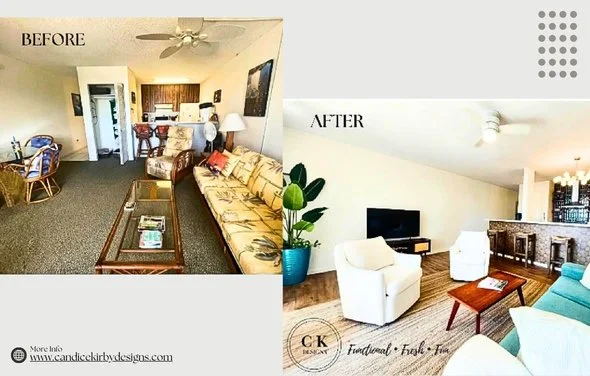
Before and after furniture space planning layout for better room flow.
When planning your remodel or new construction project, ask yourself: How will I actually live here? Do I need a quiet corner for reading, or an open area for entertaining crowds?
Bringing Functional Design to Your Big Island Home
Candice Kirby brings years of hands-on experience to ensure that your dream home doesn't just look like paradise, but lives like it too. We move beyond generic layouts to create spaces that are uniquely yours.
If your current home feels chaotic due to poor layout, it might be time for a professional perspective. Explore our Portfolio pages to see how we have transformed challenging spaces into functional retreats.
For more inspiration on island living and design, check out local resources like Hawaii Home + Remodeling Magazine (External Link) for regional trends.
Did this post help you look at your living room differently? Share it with a friend who needs a layout intervention! Tap the social share buttons below to help others discover functional design.